Cervical Mucus & Fertility—Everything You Need to Know
Key Indicator: Cervical mucus is produced in the cervix and changes in consistency and appearance depending on the phase of your cycle. It directly reflects your estrogen levels.
Changes in Cervical Mucus Throughout the Cycle:
After your period: little to no mucus, feeling of dryness.
Before ovulation: increasingly creamy, whitish, or yellowish.
Around ovulation: glassy, stretchy, or watery.
After ovulation: thick, clumpy, or no mucus.
Role in contraception (symptothermal method): Observing cervical mucus in combination with basal body temperature makes this method highly reliable.
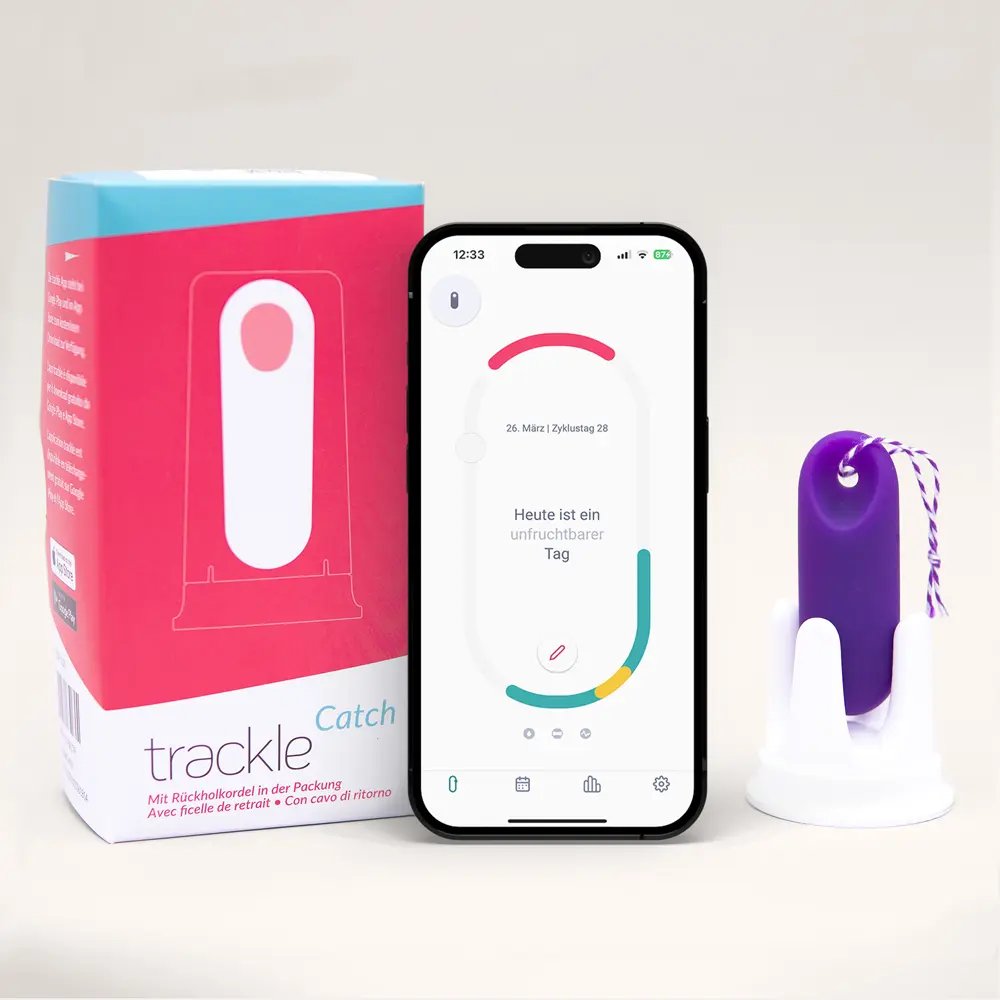
Cycle tracking with trackle: For reliable analysis, enter your daily mucus observations into the trackle app—together with your automatically measured temperature, trackle analyzes your fertile days.
Cervical mucus helps you determine your fertility. By observing the consistency of your cervical mucus throughout your cycle, you can tell whether ovulation is still to come or has already passed. Tracking your cervical mucus is very simple and an important part of the symptothermal method. Here, you’ll learn about the different phases your cervical mucus goes through, how it feels and looks, and how you can use it to gather clues about your fertility.
All the details about cervical mucus
What is cervical mucus?
Cervical mucus is a secretion produced by the glands in the cervix. It protects against pathogens and creates the ideal environment in the vagina for fertilization. Its consistency changes throughout the cycle, letting you know when you are most fertile.
How can I tell from my cervical mucus whether I'm fertile?
Cervical mucus changes throughout the cycle. At the beginning, it may not be present at all; then it tends to be whitish and creamy—and as you get closer to ovulation, the mucus becomes thinner and more stretchy. This is how you can tell that ovulation is approaching. And you’re only fertile around the time of ovulation.
What does cervical mucus look like during ovulation?
It’s best to check your cervical mucus daily—between your fingers or on toilet paper. Most women can easily classify what they observe into one of the categories used in the symptothermal method of family planning.
How do you properly monitor cervical mucus?
The thinner and more stretchy your cervical mucus is, the closer you are to ovulation. After ovulation, the appearance of the mucus changes significantly—it becomes creamier, sometimes clumpy, or disappears entirely.
The trackle Cervical Mucus Course
How does cervical mucus change throughout the menstrual cycle?
Throughout your cycle, cervical mucus changes due to the influence of the hormones estrogen and progesterone. This makes it an important indicator of your current cycle status. It can tell you exactly where you are in your cycle.
The hormone estrogen is produced by the maturing follicles before ovulation. The more estrogen is produced, the more the cervical mucus liquefies: it becomes more transparent and stretchy. The pH of estrogen-rich cervical mucus is alkaline, which helps protect entering sperm from the acidic vaginal environment.
The hormone progesterone is produced after ovulation by the corpus luteum. The more progesterone is produced, the thicker and drier the cervical mucus becomes. It no longer flows down into the vagina and seals off the cervix. This protects the body from the entry of pathogens.
The following video is embedded in YouTube’s enhanced privacy mode, which blocks the setting of YouTube cookies until you actively click the play button. By clicking the play button, you consent to YouTube setting cookies on the device you are using, which may also be used to analyze usage behavior for market research and marketing purposes. For more information on YouTube’s use of cookies, please see Google’s Cookie Policy at https://policies.google.com/technologies/types?hl=de.
How to Properly Monitor Your Cervical Mucus!
Cervical mucus can be observed in various ways: by sensing, feeling, and seeing. Since hormone levels fluctuate throughout the day, it’s important to monitor your cervical mucus over the course of the day. To assess its quality, simply wipe your finger or a piece of toilet paper across the vaginal opening (preferably before using the restroom, so as not to be confused by urine) and consider the following:
How does the vaginal opening feel? Is it dry, moist, or perhaps even wet? How does the cervical mucus feel? Does it feel slippery or slimy? What does the cervical mucus look like? Can you even see it? What color is it?
If you’re using trackle, it’s important to enter your observations into the trackle app using the standardized buttons. Only when both a cervical mucus assessment AND a temperature assessment are possible will trackle confirm your ovulation. You can find the abbreviations the app provides for cervical mucus assessment a little further down or here in the video:
The following video is embedded in YouTube’s enhanced privacy mode, which blocks the setting of YouTube cookies until you actively click the play button. By clicking the play button, you consent to YouTube setting cookies on the device you are using, which may also be used to analyze usage behavior for market research and marketing purposes. For more information on YouTube’s use of cookies, please see Google’s Cookie Policy at https://policies.google.com/technologies/types?hl=de.
Phase 1: Very little cervical mucus
After your period, the opening of your vagina often feels dry; cervical mucus doesn’t start to increase again until later. Then you might notice a moist sensation, even though you can’t see the mucus.
Phase 2: Creamy cervical mucus
As the follicle grows and prepares for ovulation, you can also tell by your cervical mucus. It is cloudy, whitish, or yellowish, and is thick, creamy, clumpy, sticky, or tacky—but not stretchy.
Phase 3: Glassy cervical mucus
The closer you get to ovulation and become fertile, the more cervical mucus you produce, and the better its quality becomes. In this case, “better” means clear, glassy, and transparent. Sometimes it has a slight yellowish tint or contains white streaks; it’s stretchy and feels slippery and smooth. Sperm feel particularly at home here.
Phase 4: Dry Phase After Ovulation
After ovulation, your cervical mucus becomes cloudy and clumpy again, or stops being produced altogether. It feels as if the entrance to your vagina is completely dry again.
What does cervical mucus have to do with natural family planning?
Monitoring your cervical mucus can help you track your cycle. It changes throughout your cycle due to hormonal influences. Cervical mucus is therefore a bodily sign that helps you determine whether or not you can get pregnant.
However, research has shown that, in terms of reliability, it’s better to monitor two bodily signs: cervical mucus AND basal body temperature. That’s why the symptothermal method is the safest form of hormone-free birth control. It provides guidelines on how to correctly observe and interpret your cervical mucus and your basal body temperature. The symptothermal method helps you determine whether you’re currently fertile or not.
What do the cervical mucus abbreviations mean?
t (“lowest” quality)
Sensations: dry, dry, rough, itchy, uncomfortable feeling AND
Appearance: nothing visible, no cervical mucus at the vaginal opening
⌀
Sensations: felt nothing, no moisture, no sensation at the vaginal opening AND
Appearance: saw nothing, no cervical mucus at the vaginal opening
f
Sensations: moist BUT
Appearance: nothing visible, no cervical mucus at the vaginal opening
S
Sensations: moist or no sensation AND
Appearance: thick, whitish, cloudy, creamy, lumpy, yellowish, sticky, milky, not stretchy or tough
S+ (“highest” quality)
There are two possibilities here:
Option 1:
Sensations: moist or nothing felt AND
Appearance: glassy, crystal clear, translucent, like raw egg white (glass-like with white strands running through it), stretchy or spinable, stringy, liquid, so thin that it “runs off like water,” reddish, reddish-brown, yellowish-reddish
Option 2:
Sensations: wet, slippery, slippery, like it’s been oiled, smooth AND/OR
Appearance: glassy, crystal clear, glassy and translucent, like raw egg white (glassy with white strands running through it), stretchy or spinable, stringy, liquid, so thin that it “runs off like water,” reddish, reddish-brown, yellowish-reddish”

Do you have any more questions?
Observing your body and your cervical mucus takes a little practice at first—and that’s completely normal! If you have questions about the symptothermal method or need help using trackle, just check out our FAQs or contact our customer support. We’ll guide you every step of the way!
This article was last updated on October 12, 2026.