Determine your ovulation using your basal body temperature.
The pattern of your basal body temperature throughout your menstrual cycle provides information about your fertility. Around ovulation, your core body temperature rises (and with it, the lowest value of your core body temperature, the „basal body temperature“). Because women are only fertile around the time of ovulation, this rise is an important indicator of fertility. On this page, you will learn more about what basal body temperature is and how it can help you determine when you ovulate.
What is basal body temperature?
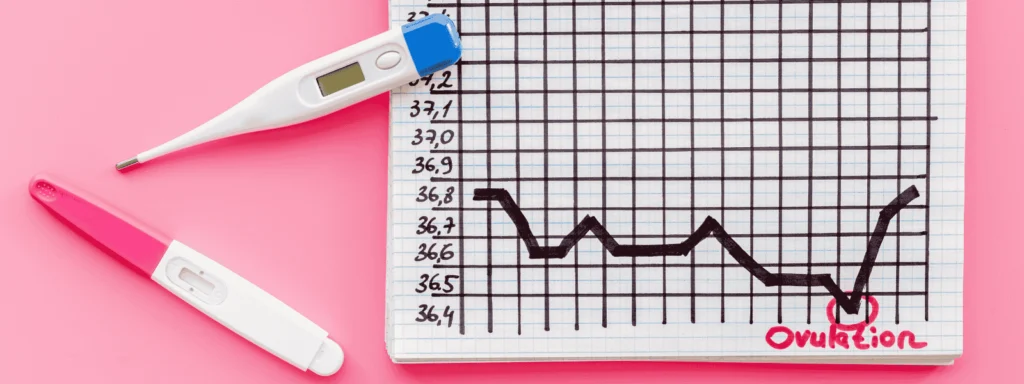
Shortly after ovulation, your body temperature regularly rises by about 0.2 degrees compared to the first half of your cycle. This reliable increase is due to the hormone progesterone, which is released in greater quantities after ovulation. Among many other effects within the cycle, it causes your body temperature to rise in the second half of the cycle. Once this temperature increase has occurred, you know: you’ve ovulated!
However, it’s not enough to measure your temperature only once during your cycle, because the absolute temperature alone doesn’t tell us how high the progesterone level is. What we need, therefore, is a temperature chart to see that your core body temperature (or the lowest value, the basal body temperature) has risen relative to the other temperature readings in your cycle.
Basal body temperature is the lowest core body temperature your body reaches at rest – that is, while you’re sleeping. It is usually measured in the second half of the night, in the very early morning hours.
What is the best way to measure basal body temperature?
The best way to measure basal body temperature is internally, because while your core body temperature remains relatively constant to ensure your organs function correctly, the temperature on the skin’s surface is subject to greater fluctuations. This is especially true the further the measurement site is from the torso. Anyone who suffers from cold feet or hands in winter will be familiar with this effect: the extremities react much more quickly to cold with reduced blood flow than the core of the body. For the same reason, it is recommended to measure fever in the ear, mouth, or rectum. Even under the armpit, body temperature can be subject to considerable fluctuations. Measuring accurate basal body temperature values is therefore not so easy, unless you measure internally, as the trackle cycle computer does.
Can I use my smartwatch for contraception?
No, because a wristwatch is not a contraceptive and should not be misused as such:
Firstly, wearables like wristwatches or rings can only measure the temperature of your skin surface. This temperature is subject to too many fluctuations to be reliably used for analysis. As a reminder: after ovulation, the temperature only rises by approximately 0.2 degrees Celsius. To determine this minimal increase, the constant core body temperature is always measured, which, as already mentioned, can only be reliably determined at a few points on the body.
Secondly, smartwatches are not approved as contraceptives and are therefore not tested for these purposes. You can read about the strict requirements that a contraceptive must meet on the European market here.
Finally, the time of measurement also plays a role, because the waking temperature is used to determine the correct basal body temperature. This is because activity and rest also influence your temperature, and it is not sufficient to simply determine the average value of your day.
Just because your wristwatch isn’t suitable as a contraceptive doesn’t mean measuring your temperature has to be complicated. You can read how to easily determine your basal body temperature in the following section.
Why is it necessary to measure throughout the entire night in order to obtain a good basal value?
You may already be familiar with this from literature on natural family planning or the symptothermal method: it is often recommended to use the so-called „waking temperature“ for evaluation, because the waking temperature is very close to the true basal temperature.
The waking temperature is the temperature measured immediately after waking up – always at the same time each day, for three minutes. Previously, it wasn’t possible to measure the actual basal temperature, which is why the waking temperature was used. However, consistently measuring the temperature at the same time every day is often difficult to implement, especially for women who work shifts, have young children, or otherwise have an irregular sleep schedule or daily routine.
The actual, precise basal body temperature can therefore only be measured in a state of complete rest – that is, while you’re sleeping!
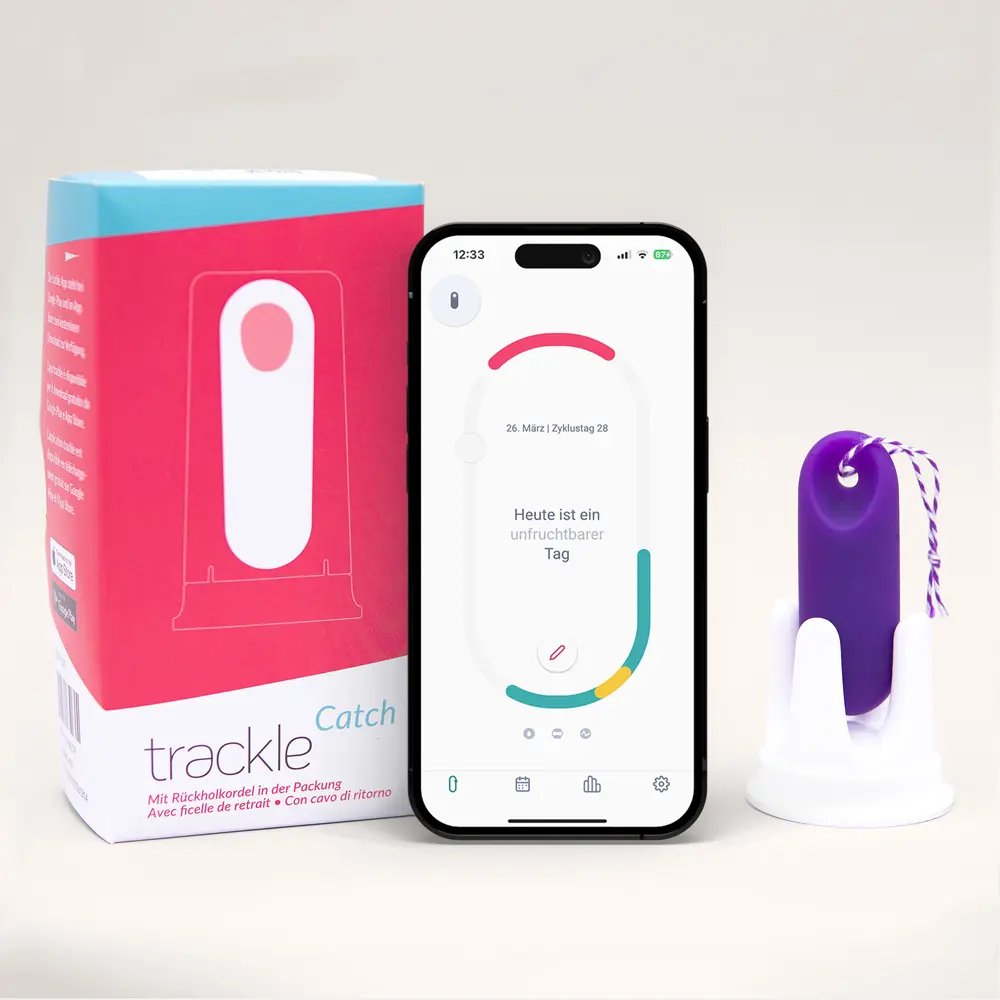
That’s why the trackle cycle computer is worn like a tampon at night and records the temperature curve, from which the basal body temperature is then determined – simply, safely, and digitally.
The next morning, you place the sensor back in its case, and from there it transmits the lowest temperature recorded during the night to the trackle app: your basal body temperature.
If you want to learn more about using trackle, take a look here.

Who is observing basal body temperature suitable for?
Observing basal body temperature for fertility tracking works for almost all women because the temperature rise around ovulation is a very reliably occurring physiological phenomenon: Anyone who ovulates will also experience a temperature increase. This method is suitable for women working shift schedules, women with irregular cycles, women trying to conceive, and women of all ages.
What external factors can influence basal body temperature?
Basal body temperature can be influenced by so-called „disrupting factors“—the extent to which this happens varies greatly from person to person. You can recognize a „disrupted“ temperature reading when your temperature suddenly rises for one or two days and then drops again without any other apparent reason (such as ovulation or an infection).
Common factors that can affect basal body temperature in many women include:
- Drug use
- Unusual alcohol consumption
- Short/disrupted sleep
- Stress
- Time zone changes
- Colds or illness
You can find more information about disruptive factors here.
Can I rely solely on basal body temperature for contraception?
The temperature method is one of the methods of natural family planning and can theoretically also be used for contraception. However, observing only one bodily sign does not provide a high level of reliability, as the temperature can be susceptible to fluctuations and only indicates the end of the fertile period – that is, when ovulation is over.
To also identify the beginning of the fertile phase in the cycle and to still be protected in case of disturbed temperature readings, another bodily sign can be monitored: cervical mucus.
When evaluated in combination, basal body temperature and cervical mucus constitute the so-called symptothermal method. This method is scientifically proven and, with a Pearl Index of less than 1, is just as reliable as the pill.
trackle also uses the symptothermal method and helps you to easily and reliably evaluate both bodily signs. This way, you always know whether today is a fertile or infertile day. Thanks to nighttime measurement and the automatic transmission of temperature data, using trackle only takes a few minutes a day.

Basal temperature & Pregnancy
Observing your basal temperature not only helps you determine if ovulation has occurred but also whether there might be a pregnancy – which is especially interesting for women trying to conceive. After ovulation, the temperature rises and remains at this higher level until the next menstruation. Then, a new cycle begins, and your core body temperature drops again. However, if your menstruation does not occur, and your basal temperature remains at a higher level for at least 18 days, it may be time for a pregnancy test or a visit to your gynecologist.