Cycle & sport - the influence on your performance
Do you feel like you could do ten HIIT workouts in a row on some days and just have no energy on others? Then you are not alone and there is a reason for this. Various studies have investigated how the female cycle can influence performance in sport.
In this blog post, we would like to present some interesting study results and give you tips on how you can train in harmony with your cycle!
The female cycle
To understand the impact of your cycle on your performance, it’s first important to understand the processes involved. You can read more about what happens during your cycle in our blog post about the cycle. Here’s a brief summary of the most relevant aspects:
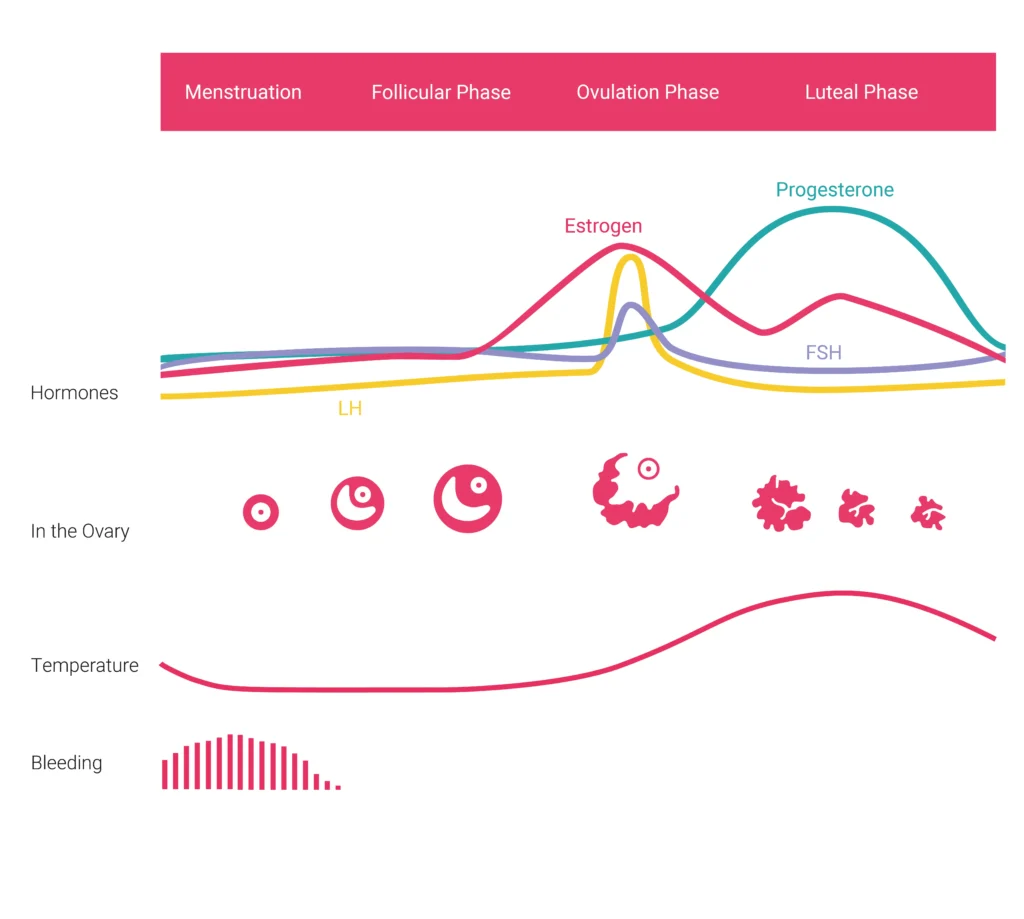
The cycle can be divided into the following four phases:
- Menstruation
- The follicular phase
- The ovulation phase
- The luteal phase
Menstruation marks the first day of your new cycle. Hormone levels are at their lowest during this period. During the follicular phase, estrogen rises and reaches its peak until ovulation. Immediately after ovulation, estrogen drops rapidly, and progesterone is produced, which dominates the following phase – the luteal phase. Estrogen also slowly rises again, which is why this phase is also called the high-hormone phase. Towards the end of the cycle, both hormones drop again, and a new cycle begins with the onset of menstruation.
But what do hormones have to do with your athletic performance?
What influence do hormones have on sports?
In our interview, Frances Weber emphasizes that our menstrual cycle has a strong influence on our bodies and can therefore also impact our performance.
For her, the term performance also encompasses cognitive areas such as motivation, concentration, and coordination. Incidentally, if you take the pill, the findings for cycle-based training unfortunately don’t apply to you, as your cycle is suppressed by it. If you’re considering stopping the pill, we have a suitable free e-book for you. But what is the influence of hormones?
Estrogen is particularly interesting. Since a 1995 study, it has been suspected that the hormone has an anabolic effect: people with a cycle are particularly productive when estrogen levels are high. According to Weber, this means that shortly after menstruation and around ovulation are good times to increase one’s performance.
Some studies have confirmed this. It has been found that our muscles have a higher strength potential during the follicular phase, and that improved maximum muscle contraction is possible during this phase. On the other hand, a decline in performance was observed after ovulation. Another 2016 study found that women who train according to the follicular phase achieve greater increases in maximum strength than those who train in the luteal phase.
How to design your training based on cycles
Now you’re probably wondering how you can perfect your training based on your cycle.
Follicular phase and the days around ovulation:
This is when you’re at your best. It’s a good idea to create new stress stimuli with intensive, high-impact training, for example, to build muscle.
Luteal phase and shortly before menstruation:
Do’s:
- Stabilize newly introduced stimuli with low impact
- Maintain performance level
- Regeneration phases to avoid further stress on the body
- Weber’s recommendation: Time for relaxation both before and after
training - Practice familiar movement sequences
- Nutritious diet
Don’ts:
- Increase performance level
- Do not include recovery phases
- Do challenging coordination exercises (especially during PMS)
- Do not eat enough, as an empty stomach during the luteal phase can cause additional stress for the body

If you want to train cycle-based, our trackle can also help. With trackle, you always know which phase of your cycle you’re in and can adjust your training accordingly. Learn how our trackle works here.
Sources
Phillips, S. K./ Sanderson, A. G./ Birch, K./ Bruce, A./ Woledge, R. C. (1996): Changes in maximal voluntary force of human adductor pollicis muscle during the menstrual cycle, Journal of Physiology, Vol. 496, Heft 2, S. 551-557, (online) https://physoc.onlinelibrary.wiley.com/doi/epdf/10.1113/jphysiol.1996.sp021706.
Reis, E./ Frick, U./ Schmidtbleicher, D. (1995): Frequency Variations of Strength Training Sessions Triggered by the Phases of the Menstrual Cycle, in: Int. J. Sports Med., Vol. 16, No. 8, S. 545 – 550.
Shakalio, S./ Hainc Scheller, C./ Gronwald, T. (2019): Menstruationszyklusbasiertes Training im Leistungssport. Ein narratives Review mit trainingspraktischen Schlussfolgerungen für Ausdauersportarten, in: (2020), Trainingswissenschaft und -Lehre, Heft 1, S. 28-31, (online) https://www.researchgate.net/profile/Thomas-Gronwald/publication/338645773_Menstruationszyklusbasiertes_Training_im_Leistungssport_-_Ein_narratives_Review_mit_trainingspraktischen_Schlussfolgerungen_fur_Ausdauersportarten/links/65c0993e34bbff5ba7eeac6f/Menstruationszyklusbasiertes-Training-im-Leistungssport-Ein-narratives-Review-mit-trainingspraktischen-Schlussfolgerungen-fuer-Ausdauersportarten.pdf.
Sung, E./ Han,A./ Hinrichs, T./ Vorgerd,M./ Manchado,C./ Platen,P. (2014): Effects of follicular versus luteal phase-based strength training in young women, (online) https://springerplus.springeropen.com/articles/10.1186/2193-1801-3-668.
trackleTalk (2024): Zyklusbasiertes Training: Tipps von Sportwissenschaftlerin Frances Weber für Dein Workout im Einklang mit dem Zyklus, (online) https://open.spotify.com/show/2S3Kwp074vyrLL2iQy01tR.