
What is the pelvic floor?
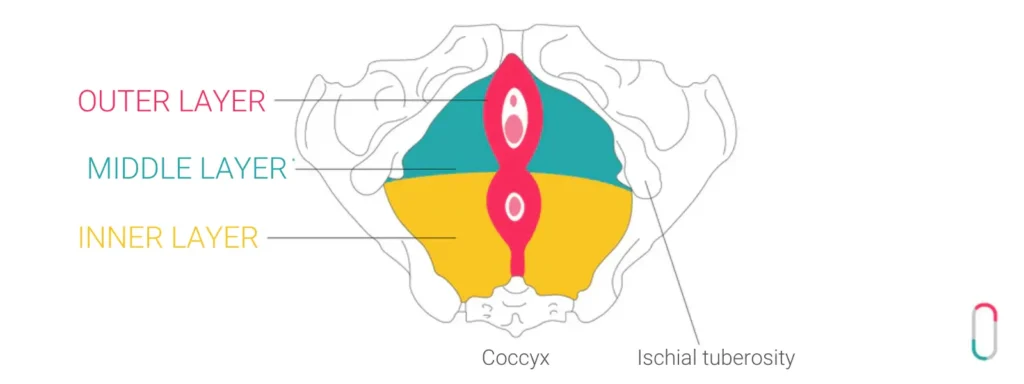
The pelvic floor is a muscular plate that closes off the abdominal cavity and the pelvic organs from below. It essentially supports our organs, and during pregnancy, it even carries the increasingly heavier baby. It consists of three layers of muscles stacked on top of each other in a fan-like manner.
The innermost muscle layer is called the diaphragma pelvis. It is the strongest and largest of the three layers. The longitudinally oriented gap (for urinary and genital tracts) is the weakest point of the pelvic floor in women.
The middle layer is also called the diaphragma urogenitale. This muscular plate is about one centimeter thick and is trapezoidal, lying between the pubic bones. The erectile tissue and sphincter layer extend from the pubic bone to the coccyx and encircle the vagina and anus like a figure eight. This is the outer pelvic floor layer.
When stacked on top of each other, the pelvic floor looks something like this:
What is the pelvic floor for?
The various muscle layers ensure that the bladder, uterus, and rectum are kept in place despite gravity and natural processes such as sneezing, laughing, and exertion.
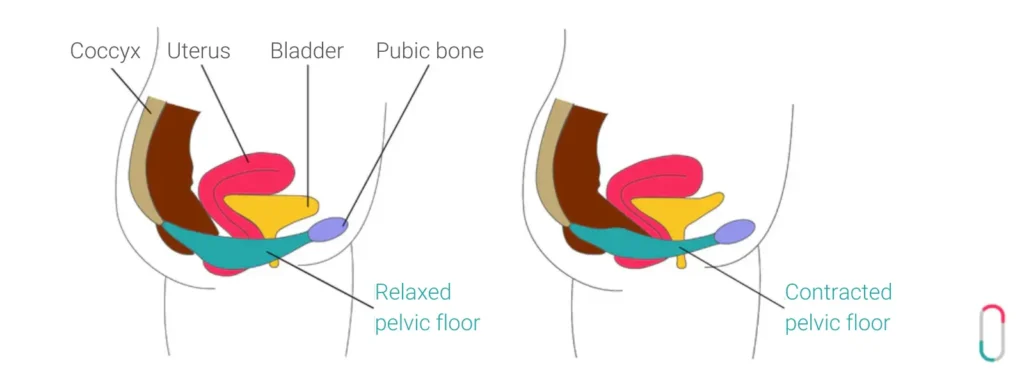
In essence, the pelvic floor has 3 main functions: tightening, relaxing, and reflexively resisting. Let’s take a closer look at these:
Tightening
Particularly important for maintaining continence! Here, the pelvic floor muscles support the lower part of the urethra, the sphincter of the bladder, and the anus!
Relaxing
When are you truly relaxed? Exactly – during urination, bowel movements, for women during sexual intercourse, and for men during erection!
Reflexively resisting
Sounds pretty strenuous and incredibly important! This is where men and women most commonly notice that their pelvic floor has a weakness.
Because during reflexive resistance, the pelvic floor ensures that there is no urine loss when coughing, sneezing, jumping, laughing, or carrying heavy loads.
Pelvic Floor and Sexual Intercourse
Many people say that the pelvic floor is the key to good sex. But why do they say that? When you train your pelvic floor, these muscle regions are supplied with more blood. What is better supplied with blood, also feels better. So that’s how you can also increase your sexual arousal!
Another positive aspect: when you engage more with your pelvic floor, you get a better feel for your genital area. The more active your pelvic floor, the better your muscles can grip and release something, so the more intense it is for you and your partner. To do this, you need to alternately tense and relax your pelvic floor.
To get to the point:
- The pelvic floor can help you to reach orgasm.
- It helps you to get a better feeling for your body
- It brings variety to lovemaking
PS: Of course, a well-trained pelvic floor also has a positive effect on the prostate.
Preventing Pelvic Floor Weakness
How can you prevent pelvic floor weakness?
- Eat healthily
- Exercise regularly
- Perform pelvic floor exercises
- Avoid lifting heavy objects, or if lifting heavy objects is necessary, please do so in a back-friendly manner!
- Drink plenty of fluids
- Avoid prolonged standing

Exercises for a Strong Core
The pelvic floor can be trained in various ways. It’s important to execute the exercises correctly. Often, women don’t know how to properly engage their pelvic floor without tensing the abdominal muscles or the anus.
Nowadays, there are apps that support training. Some health insurance companies even cover the costs of certain pelvic floor courses. Also helpful can be so-called ‚love balls.‘ These are used while doing other activities (cleaning windows, vacuuming, etc.). By the way, stories of continuous orgasms while wearing love balls are just myths. 😉 You can try out love balls, for example, from our friends at Fun Factory, the largest European manufacturer of silicone erotic toys. And as you know, we’re experts in silicone…
After pregnancy, the postpartum recovery course helps regenerate and strengthen the pelvic floor. We recommend taking postpartum recovery seriously and training regularly.
Sources: