All about ovulation
Ovulation is the central element in the female cycle – the interplay of various hormones ensures that the mature egg leaves the ovary and begins its journey through the fallopian tube. This is the moment of ovulation – and only from the moment the egg starts its journey is fertilization possible.
It’s worth taking a closer look at ovulation itself, as it plays a significant role in family planning. Knowing exactly when your ovulation occurs allows you to calculate when you are fertile and when you are not.
Learn more about your ovulation now and get to know yourself and your body better.
What is ovulation?
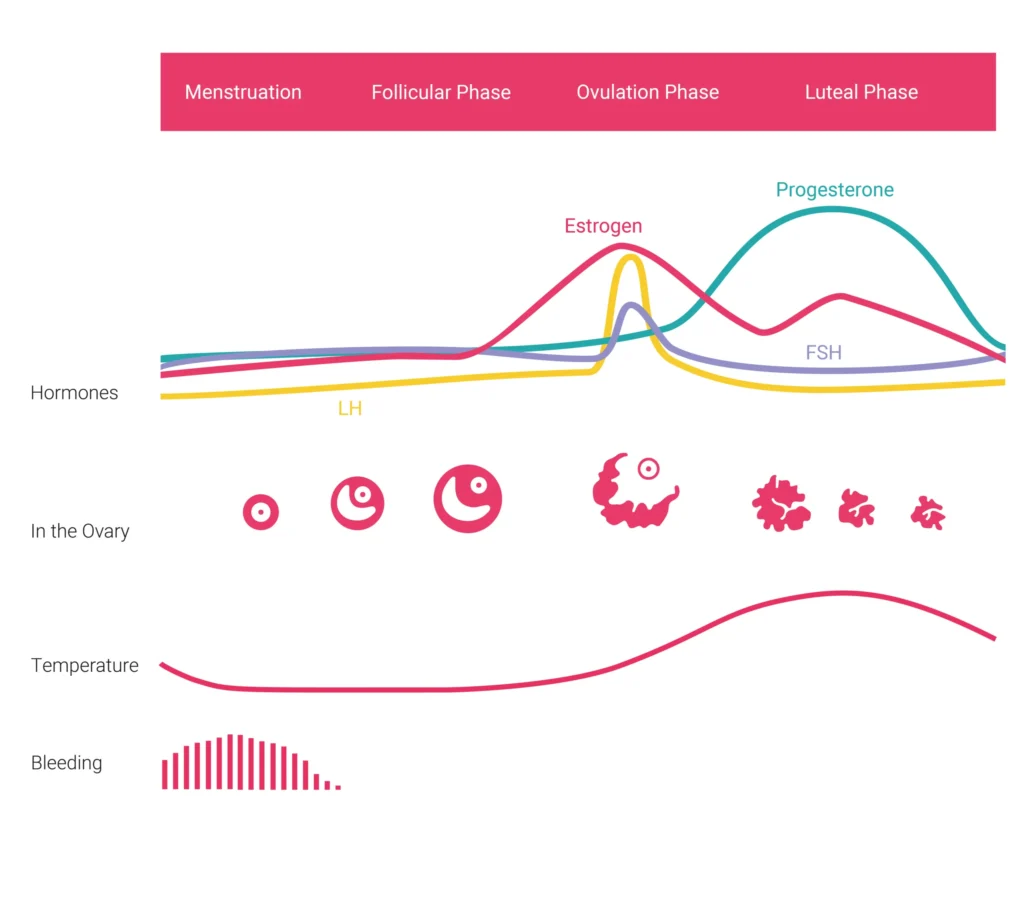
Ovulation is the moment when the mature egg is released from the ovaries into the fallopian tube. The mature egg then travels toward the uterus and can be fertilized.
Triggered by the hormone FSH (follicle-stimulating hormone), multiple eggs grow in the ovaries. Each egg is surrounded by a structure called a follicle. Within the wall of this follicle, the hormone estrogen is produced.
There’s a competition among the developing follicles: one follicle grows the fastest and signals readiness. Then, the hormone LH (luteinizing hormone) comes into play, leading to the so-called ovulation: the winning follicle ruptures and releases the egg into the fallopian tube, where it begins its journey toward the uterus.
When does ovulation occur?
In theory (with a perfectly regular 28-day cycle), ovulation statistically occurs on the 14th day of the cycle. However, in reality, this calculation applies to fewer than 20% of women.
When does ovulation shift?
The timing of ovulation can vary in each cycle. Hormones respond to our life circumstances: the egg develops to potentially be fertilized, and the body closely monitors the conditions. Factors such as stress, illness, psychological processes, travel, etc., can cause ovulation to shift and change cycle lengths.
A particular situation is the first ovulation after childbirth. We have written a separate article on this topic, which you can find here: Ovulation after childbirth & during breastfeeding.
How can you calculate ovulation?
Ovulation cannot be calculated mathematically or statistically based on the length of the menstrual cycle because this method of calculation does not take into account individual circumstances and life factors. The day of ovulation can vary in each cycle – that’s why it’s important to check the current fertility status precisely and not rely solely on the calendar. Whether ovulation is approaching or has already occurred can be determined, for example, by observing bodily signs, such as changes in basal body temperature and cervical mucus – as prescribed by the symptothermal method and implemented by trackle.
The fertile days
When am I fertile?
The egg doesn't last as long as many people think: only about 12 to 18 hours after it's released from the follicle, it can be fertilized by a sperm. Nature has come up with a clever solution to extend this window: sperm can survive in the female body for up to five days – theoretically, having intercourse up to four days before the day of ovulation is enough to catch the fertilization window of the egg.
When exactly are the fertile days?
The fertile days are the days when you can get pregnant. Since sperm can survive in the female body for up to five days, the following period is considered fertile: the four days before ovulation, the day of ovulation itself, and the two days afterward. trackle knows all of this: In the analysis in your trackle app, all fertile days around ovulation are displayed as such. This allows you to precisely determine when you are fertile.
Recognizing Ovulation: These are the Signs
In theory (with a perfectly regular 28-day cycle), ovulation statistically occurs on the 14th day of the cycle. However, in reality, this calculation applies to fewer than 20% of women.
Cervical Mucus
The hormones estrogen and progesterone cause changes in cervical mucus. As ovulation approaches, the cervical mucus becomes clearer and more stretchy. When you have it between your fingers, it forms threads – it's more stretchy. In appearance, it resembles raw egg whites.
Cervix
The cervix, or uterine cervix, is also influenced by the hormones of the female cycle. At the beginning of your cycle, the cervix is rather firm and protrudes into the vagina. As ovulation approaches, the cervix softens, opens, and may even rise slightly higher. You can examine the cervix yourself by inserting two fingers into the vagina, feeling how the cervix feels.
Temperature
The hormone released after ovulation – progesterone – causes your basal body temperature to rise, by about 0.2°C. However, it's not enough to measure your temperature just once, as the temperature alone doesn't tell you how high the progesterone level is. To detect an increase, you need to track your temperature over time.
Mittelschmerz
Mittelschmerz is a stabbing or pulling sensation in the lower abdomen observed by some women around ovulation. Mittelschmerz is not necessarily an indication that ovulation is happening at that moment. It occurs only in some women near ovulation.
Intermenstrual bleeding
Sometimes you can also recognize ovulation by intermenstrual bleeding. This is a light bleeding or spotting that occurs in some women near ovulation. Intermenstrual bleeding can either be a light reddish discoloration of cervical mucus or even resemble a light period. Spotting is therefore a sign of high fertility.
Change in libido
Many women report feeling more desire for sex around ovulation. The likely reason for this change in libido is the rising estrogen levels. It seems our primal instinct kicks in: It makes sense to have more desire for sex during the fertile period – at least from an evolutionary and reproductive perspective.
How trackle helps you recognize your fertile phase
Here’s how trackle can help you determine your fertile window and thus assist with hormone-free contraception or achieving your desire to conceive.