The 8 Biggest Menstrual Cycle Myths
In the world of the female menstrual cycle, there is plenty of dangerous misinformation circulating on the internet: from harmless theories like the influence of the moon on your menstruation to more serious misconceptions about fertility – the list of menstrual cycle myths is long. In this blog post, we’ll examine the 8 biggest menstrual cycle myths and explore what lies behind them!
Menstrual Cycle Myth 1: A normal cycle lasts 28 days.
No, that´s not true. This myth seems to originate from the ancient belief in a connection between lunar phases and menstrual bleeding. Consequently, it’s assumed that the length of the female cycle corresponds to the 28-day lunar month. However, a 28-day cycle, contrary to popular belief, is more of an exception: According to a study, only about 13% of all cycles are exactly 28 days long. In medicine, cycles ranging from 23 to 35 days are considered normal and do not indicate irregular cycles. However, occasional deviations can occur, leading to shortened or prolonged cycles, as the female body is highly sensitive to factors such as stress, illness, or medication.
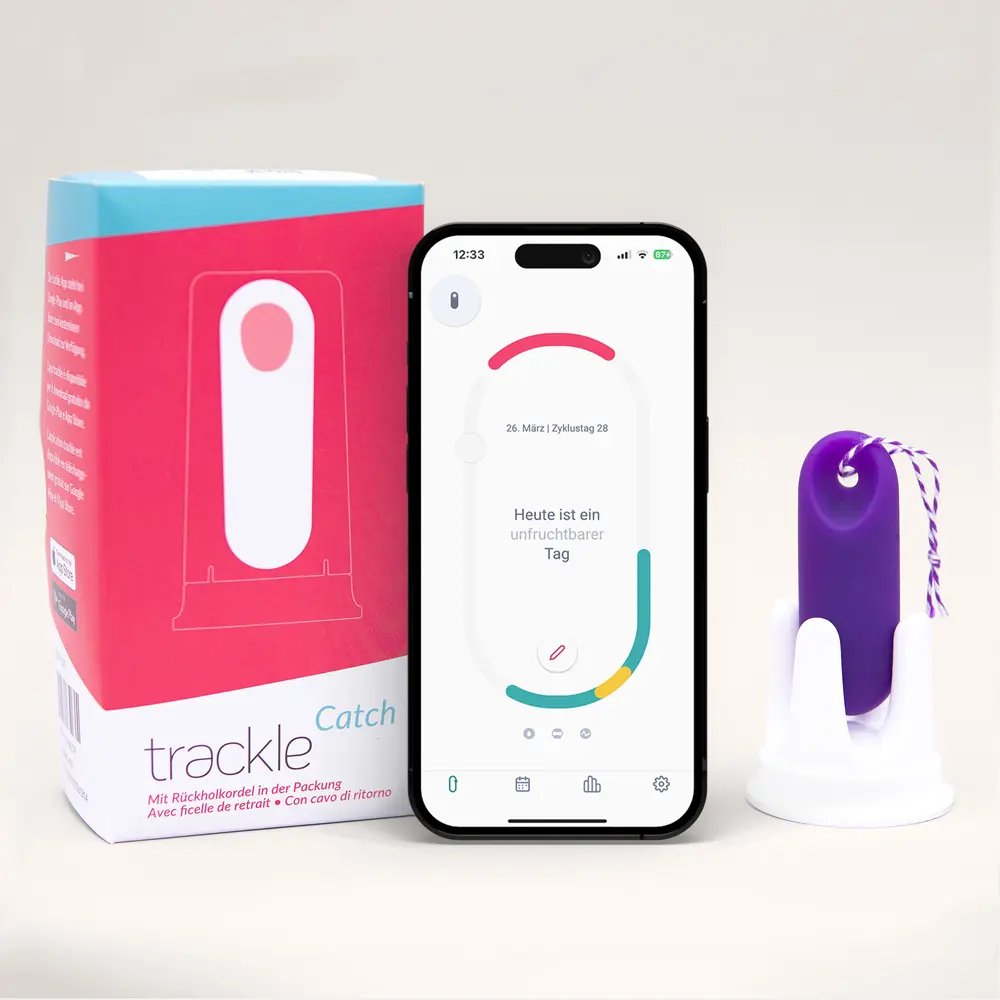
Would you like to use hormone-free contraception but are worried that your cycle may be irregular? Then we can reassure you: With the symptothermal method, it is not relevant whether your cycle is regular or not. Your cervical mucus and core body temperature are monitored and evaluated daily. The symptothermal method therefore helps you to reliably and precisely determine your individual fertile window in each cycle and can therefore be used for contraception. With trackle, this process is quite simple – learn more about it here.
Cycle Myth No. 2: Ovulation always occurs on the 14th day of the cycle.
This myth goes hand in hand with Myth No. 1: Assuming that ovulation occurs exactly in the middle of the cycle and that a cycle is always 28 days long, then the 14th day of the cycle marks the day of ovulation. However, extreme caution is warranted here because you cannot rely on the cycle always being 28 days long, nor can you assume that ovulation will occur on day 14 of a 28-day cycle. In fact, the timing of ovulation can vary significantly. Even if you generally have regular cycles, the timing of ovulation primarily depends on your first cycle phase, known as the follicular phase. Therefore, ovulation can occur very early in short cycles, while it may take several weeks for ovulation to occur in long cycles.

Cycle Myth No. 3: You can calculate ovulation (for contraception)
Many websites lure with so-called ovulation calculators, and there are numerous apps that promise just that: an ovulation forecast, which sometimes even indicates fertile and infertile days in your cycle. Extreme caution is advised here because just with a few details about your last periods or a few body symptoms, ovulation cannot be accurately calculated. Even body signs like mid-cycle pain, sensitive breasts, or increased sex drive cannot confirm with certainty that ovulation is occurring.
But perhaps you’re now asking yourself, „How do I calculate my ovulation?“ The unfortunate answer to that is: You don’t — because ovulation cannot be determined in advance. So never rely on the calendar method, an ovulation calculator, or a cycle app if you want to prevent pregnancy securely: They all essentially rely on the calendar method, where, with typical use, every 5th woman becomes pregnant.
The good news is: To naturally prevent pregnancy, you can accurately identify the infertile days in your cycle — namely, with the symptothermal method. It determines post-ovulation (retrospectively) that ovulation has safely passed and has been proven effective in providing an accurate statement about your fertile window.
Cycle Myth No. 4: You are only fertile during ovulation
Also surrounding this myth, there are wild variations that we would like to clarify once and for all: The fact is: You can only get pregnant for a maximum of 12-18 hours after ovulation, because only during this time can the egg be fertilized by a sperm. BUT: Your fertile window in a cycle lasts up to 7 days – and this has two important reasons:
Reason number 1: The exact timing of ovulation cannot be determined precisely in real time. While it has been scientifically proven how long an egg can be fertilized before it ultimately dies and dissolves, the exact time when the egg bursts from the ovary cannot be determined externally. However, it is possible to narrow down the timeframe of ovulation: According to studies, it occurs in the period between 4 days before and one day after the first higher measurement of your basal temperature observation.
Reason number 2: Mother Nature has also come up with something clever to extend the fertile period and increase the chances of pregnancy. Sperm can survive in the female body for up to 5 days. The female cervical mucus helps them with this, as it changes cyclically and creates perfect conditions for the little swimmers around ovulation (Nevertheless, if you ask us, the female body is doing the more hardcore job here).
Anyways – due to the survival ability of sperm and the egg itself, there is a combined fertility period of up to 7 days per cycle. Pregnancy cannot occur on all other days.
You might suspect it, but we would also like to point out at this point: The symptothermal method (e.g., with tracke) reliably detects these fertile days through daily observation of basal temperature and cervical mucus. This provides a „double check,“ allowing fertile and infertile days to be distinguished very accurately.
Cycle Myth No. 5: It's not possible to get pregnant during menstruation
For this myth, let’s approach the proverbial horse from the rear: It’s certain that your period occurs 12-16 days after ovulation – provided you’ve accurately determined it. This scientifically proven fact is not only mind-blowing but also super helpful in everyday life. During the so-called luteal phase (after ovulation), you cannot get pregnant because ovulation has already passed, and fertilization cannot occur. However, it’s different in the time BEFORE ovulation: As explained in the previous myths, ovulation in the cycle can vary significantly and cannot be reliably predicted in advance. While implantation cannot occur directly during menstruation because the uterine lining is being shed, sperm can survive in the female body for up to 5 days – and this is where it can become critical: For instance, if your ovulation occurs on cycle day 10 and you have unprotected intercourse on cycle day 5 during your period, it could lead to pregnancy.
Cycle Myth No. 6: After discontinuing the pill, you are initially infertile
Many people with a menstrual cycle report long, irregular cycles, and missed periods after discontinuing the pill. This can make it difficult for them to conceive quickly because after discontinuation, ovulation may indeed take some time to occur. However, this is not necessarily the case and varies greatly from person to person. In general, after stopping the pill, you can become pregnant immediately – and therefore should assume fertility and use contraception if you do not wish to conceive.
If you want to become pregnant immediately after stopping the pill, gynecologists recommend waiting until the first menstrual period so that your uterine lining has enough time to rebuild itself.
Cycle Myth No. 7: Multiple ovulations can occur within one cycle.
This myth actually has some truth to it for a change: It’s generally possible for multiple ovulations to occur within one cycle. Fraternal twins are an example of this phenomenon. However, multiple ovulations in one cycle are very rare, and they occur within a few hours. What definitely isn’t possible is for another ovulation to occur several days after one has already taken place. This is because of the hormone progesterone, which is released after ovulation. It not only causes your basal body temperature to rise by at least 0.2 degrees Celsius but also prevents the maturation of further egg follicles.
For the reliability of the symptothermal method, multiple ovulations within a few hours are not a problem. This is ensured by the fertile window, which lasts for several days and thus also includes and takes into account any other possible ovulations.
As for where this myth comes from, with your newly acquired knowledge, it’s quite evident: It’s often claimed that ovulation occurs on cycle day 14 and that one becomes pregnant ‚just before the period.‘ If a pregnancy occurs despite ‚waiting for the fertile days,‘ it can only be attributed to another ovulation in that cycle.
However, the truth is that ovulation simply did not occur on cycle day 14 in that cycle but rather later, allowing fertilization to take place. The same applies to cycle apps and ovulation calculators that predict your fertile days based on your past cycle lengths. Please do not rely solely on them!
Cycle Myth No. 8: You cannot get pregnant while breastfeeding
It is generally true that exclusive breastfeeding in the early postpartum period leads to lactational amenorrhea – preventing ovulation, causing the absence of menstruation, and thus excluding the possibility of pregnancy. However, if your breastfeeding intensity decreases even temporarily or if your baby regularly sleeps through the night without needing to breastfeed, your ovulation and fertility can quickly return. The exact timing of this can vary greatly: Some mothers experience this sooner, while others wait longer for their first ovulation after delivery and subsequently for their menstrual cycle to resume.
So, during breastfeeding, you should generally assume fertility because the first ovulation after delivery occurs before the first menstrual period returns. This happens without being noticed. You can find out when you can safely use trackle for contraception again after childbirth or breastfeeding here.
We hope you feel more enlightened now and can boast about your new knowledge of the menstrual cycle. By the way, you can find even more comprehensive knowledge about the female cycle, fertility, and the symptothermal method in our free webinars on hormone-free contraception and fertility.
Sources:
- Die Pille. Familienplanung.de (BZgA)
- Diedrich, K. et al.: Gynäkologie und Geburtshilfe. 2. Auflage. Heidelberg, 2007
- Frank-Herrmann, P. et al.: Natürliche Familienplanung heute. Modernes Zykluswissen für Beratung und Anwendung, 6. Auflage. Heidelberg, 2020
- Gibt es einen zweiten Eisprung? MFM Deutschland e.V.
- Malteser Arbeitsgruppe NFP: Natürlich und sicher. Natürliche Familienplanung mit Sensiplan. Das Praxisbuch. Neuauflage. Köln, 2021
- Sexualität, Verhütung und Kinderwunsch in der Stillzeit. Still-Lexikon