
Breast cancer early detection: How to examine your breasts correctly
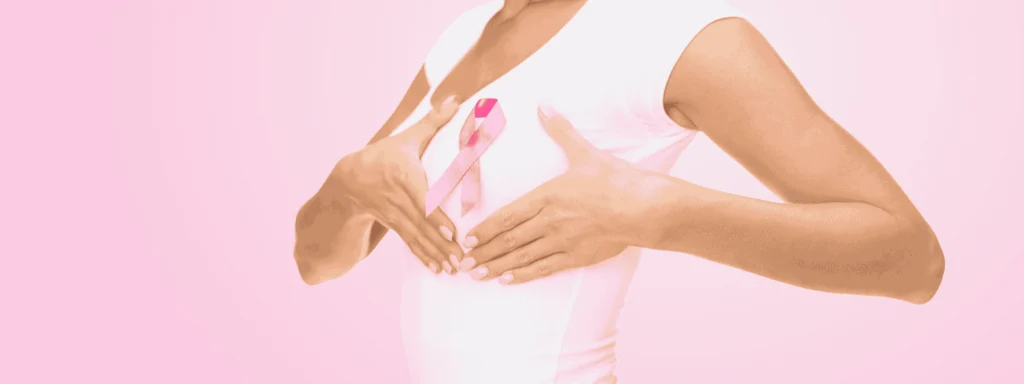
Regular self-examination of your breasts is a simple but valuable step in breast health:
It helps you to get to know the normal look and feel of your breasts so that you can notice any changes early on.
Although it is not a substitute for a medical examination or mammogram, if you discover something unusual, you can react early.
Important: The aim is to establish a routine that helps you to be attentive to your body.
When and how often?
- You should examine your breasts once a month to get a good feel for any changes.
- If you have menstrual cycles, you should examine your breasts about a week after the start of your period. Your breasts will usually be less swollen or sensitive at this time.
- If you no longer have periods or have irregular cycles, you should choose a fixed day each month that is easy for you to remember.
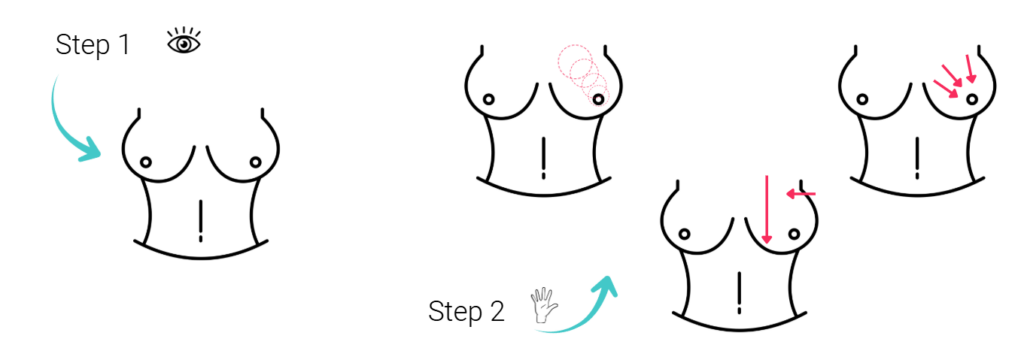
Step 1: Visual inspection
- Stand in front of a mirror and let your arms hang loosely at your sides. Look closely at your breasts and pay attention to any changes. By the way, it is very rare for your two breasts to look exactly the same.
- Then slowly raise your arms and let them fall again. Pay attention to how your breasts and nipples move, and note any skin folds or bulges that appear.
Step 2: Palpating the breast
- Place the hand on the side you are palpating behind your head. You can now palpate your breast with the three middle fingers of your other hand. Increase the pressure evenly.
- Start with circular movements from the outside in. The circles should become smaller as you move toward the nipple.
- Then palpate in a linear fashion, i.e., from top to bottom and from the outside to the inside.
- Finally, you should palpate in a linear fashion from the outside toward the nipple.
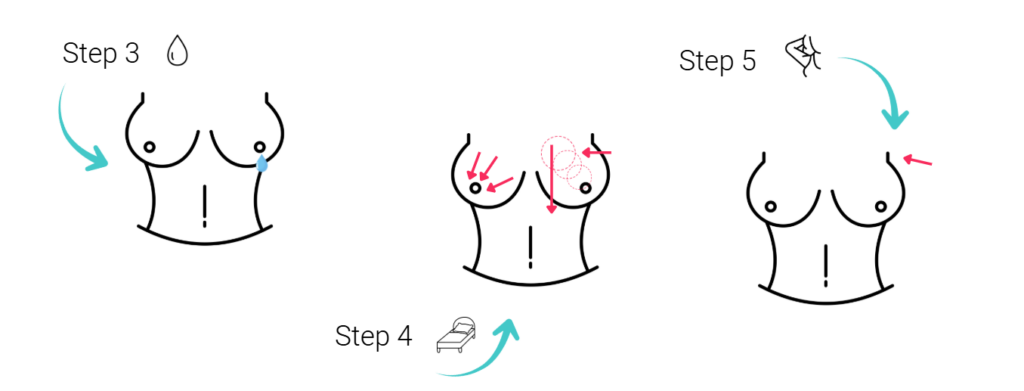
Step 3: Checking the nipples
- Gently squeeze the nipple between your thumb and index finger. If you notice any colored discharge or fluid, you should consult a gynecologist.
Step 4: Palpation while lying down
- Now lie on your back and repeat the palpation of the breast with the three movements.
Step 5: Check your armpits
- To examine your armpits, stretch one arm up high. Gently press against your chest wall and check for any hard lumps.
Regular breast self-examination is an important step in the early detection of breast cancer, but it does not replace preventive care from your gynecologist. If you are unsure or discover any abnormalities, please consult a gynecologist.