
What rules does trackle use for evaluation?
The trackle cycle computer supports you in reliably evaluating your cycle and understanding whether you can currently conceive or not.
This evaluation is done using the symptothermal method, a highly secure method of natural family planning (NFP).
In the symptothermal method (STM), fertility indicators such as core body temperature and cervical mucus are observed and evaluated according to predefined calculation rules. With this evaluation, whether you are currently fertile or not, you can then safely prevent pregnancy or fulfill your desire to conceive.
The calculation rules of the symptothermal method, with which trackle evaluates your data, have been researched and established through several studies (see studies by Freundl G, Frank-Hermann P, Gnoth C et al.).
These rules are sometimes very complex and are usually painstakingly learned by the user and manually evaluated daily on a cycle sheet.
The trackle cycle computer digitizes these rules and helps you apply them safely and easily: Based on your individual fertility indicators, namely core body temperature and your observation of cervical mucus, trackle applies the rules of the symptothermal method daily for you. This helps avoid errors in the user’s evaluation and increases the application safety of this contraceptive method.
If you still want to know the rules by which trackle evaluates your signs, you’ve come to the right place: On this page, we explain in detail the rules of the symptothermal method.
Note: For the safe use of trackle, it is not necessary to manually apply all the rules of the STM. What is important here is that you follow the instructions for use of trackle to ensure correct use. This includes correct observation and entry of your symptothermal data into the app.
If you have any questions about usage or need assistance, you can always contact our support team at info@trackle.de. Furthermore, you will find extensive knowledge resources on application, observation, and evaluation on our website and YouTube channel.
For comprehensive knowledge of the method, we also recommend the book: „“Natürlich und sicher – Das Praxisbuch: Familienplanung mit Sensiplan.
Physiological Basics
The symptothermal method helps you to understand where you are in your cycle. This is because your cycle status is the key information about whether you can currently get pregnant or not.
We would therefore like to briefly explain the most important features of the female cycle. If you are interested in more detail about the interaction of your hormones during the different phases of your cycle, you can find more information here.
Each cycle begins with the first day of menstruation and takes place in two phases: The first phase begins with menstruation and ends with ovulation. The second phase of the cycle begins with ovulation and ends with menstruation in the next cycle.
In each cycle, the fertile phase lasts a maximum of seven days. These seven days include ovulation itself, during which the egg can be fertilized for approx. 12-18 hours, as well as up to five days beforehand, as sperm can survive in the female body for up to five days. This means that unprotected sexual intercourse up to four days before the day of ovulation, on the day of ovulation itself and up to around two days after ovulation can lead to pregnancy, which makes a total of around seven days per cycle.
However, ovulation does not always take place on the same day of the cycle, but sometimes earlier and sometimes later. In order to determine the fertile days as accurately as possible, ovulation must therefore be found.
Changes in two bodily signs can be observed around ovulation: The appearance of cervical mucus and the change in core body temperature.
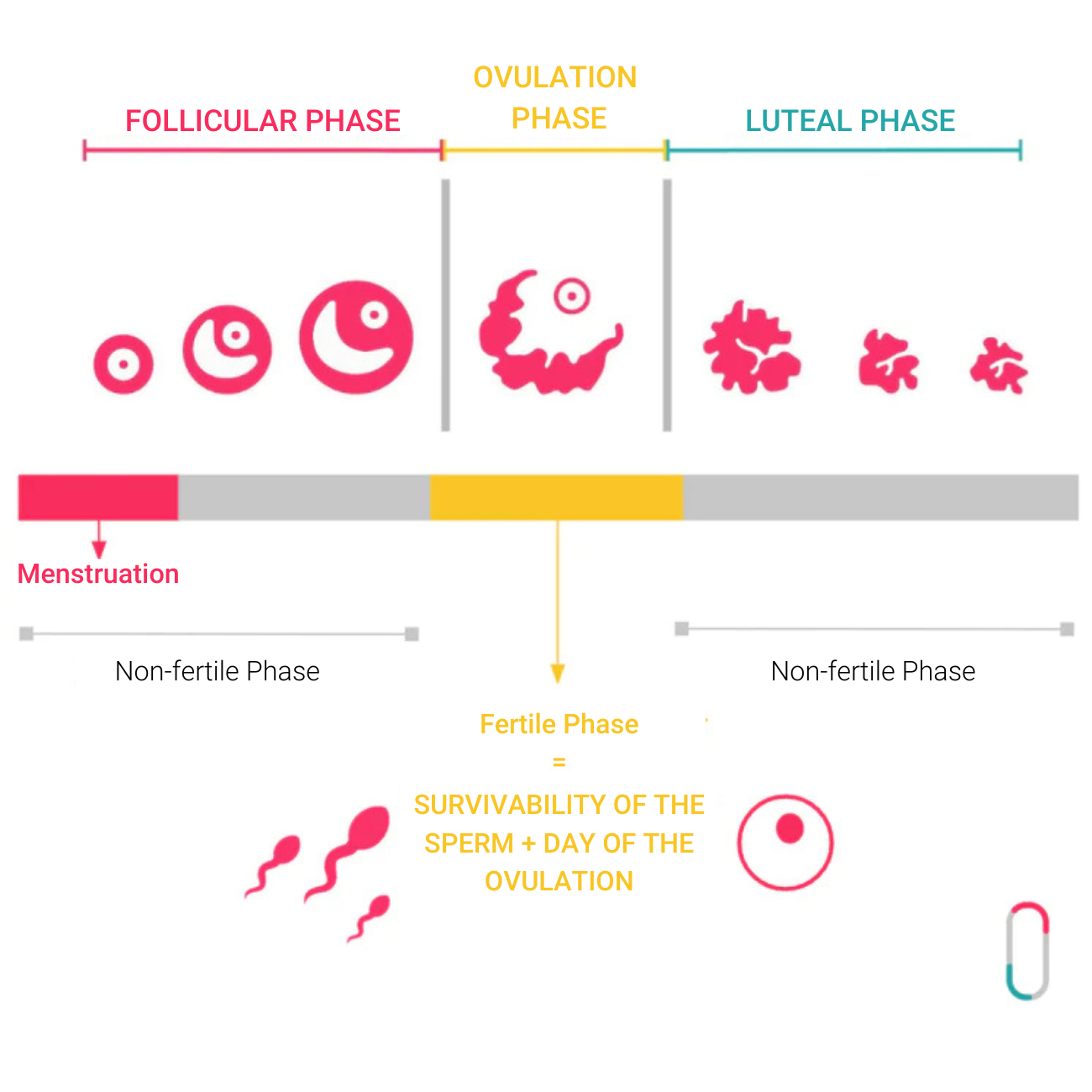
Overview of the rules
trackle evaluates the body signs according to the rules of the symptothermal method. First of all, it is assumed that every day can be regarded as potentially fertile – unless a day can be released as infertile according to the rules of STM.
The evaluation of the infertile phase before and after ovulation are each based on different rules, which are explained below. Both are based on the determination of ovulation
Rules for determining the infertile phase after ovulation
According to the rules of the symptothermal method, ovulation has taken place when these two conditions are met:
1. a cervical mucus peak has taken place
This means that the highest quality of cervical mucus you have observed is followed by three days of clearly lower quality. To do this, the cervical mucus must be observed several times a day and entered into the app.
The highest quality does not always have to be S+: Cervical mucus of quality S or f can also be the peak here if it is followed by three days of lower quality.
The cervical mucus quality is classified according to the following classification:
- t: lowest classification of cervical mucus observation is selected if:
Sensation:
dry, dry rough, itchy, unpleasant feeling ANDAppearance:
nothing seen, no cervical mucus at the vaginal entrance - ∅ is selected if:
Sensation:
nothing felt, no moisture, no sensation at the entrance to the vagina ANDAppearance:
nothing seen, no cervical mucus at the entrance to the vagina - f is selected if:
Appearance:
moist BUTAppearance:
nothing seen, no cervical mucus at the entrance to the vagina - S is selected if
Appearance:
moist or nothing felt ANDAppearance:
thick, whitish, cloudy, creamy, lumpy, yellowish, sticky, milky, non-pullable or viscous - S+ there are two possibilities here:
possibilities 1:
Appearance:
moist or nothing felt ANDAppearance:
glassy, crystal clear, glassy translucent, like raw egg white (glassy interspersed with white threads), stretchy or spinnable, stringy, liquid, so thin that it „“runs away like water““, reddish, reddish-brown, yellowish-reddishpossibilities 2:
Appearance:
damp, wet, slippery, slippery, slippery, as if oiled, slippery AND / ORAppearance:
glassy, crystal clear, glassy translucent, like raw egg white (glassy interspersed with white threads), stretchy or spinnable, stringy, liquid, so thin that it „“runs away like water““, reddish, reddish-brown, yellowish-reddish
You can find more information about cervical mucus and its properties here. If the highest individually observed cervical mucus quality is reached again before the evaluation of the temperature peak could be completed, the determination of the cervical mucus peak must be started again from the beginning.
2. a temperature rise has taken place
After ovulation, your core body temperature rises by approx. 0.2°C – this is called a temperature plateau:
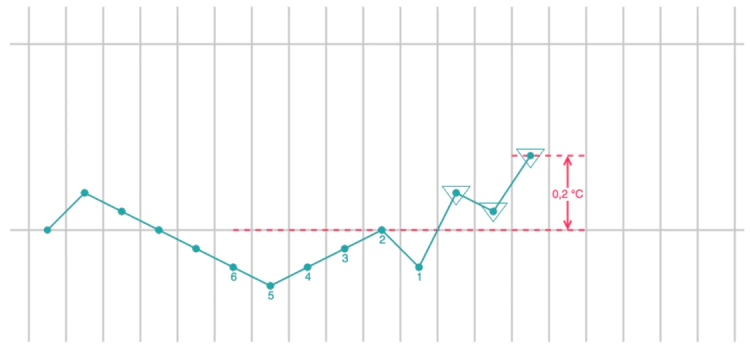
Basic rule for temperature rise
A temperature rise has occurred when three consecutive measurements are higher than the six preceding measurements (see dashed guideline). The third higher measurement must be at least 0.2 degrees higher than the highest measurement of the six preceding lower values.
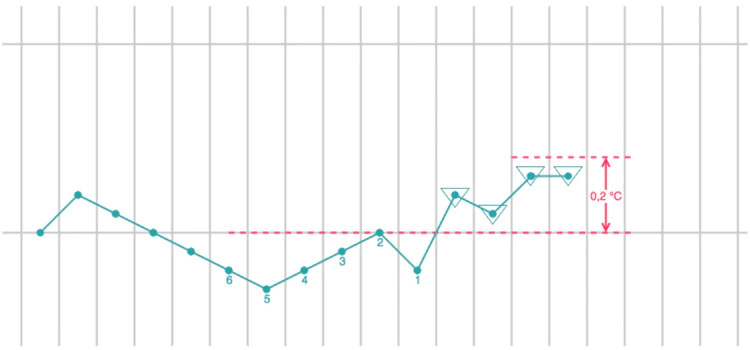
Exception rule 1
If the third temperature value is not at least 0.2 degrees higher, a fourth value must be awaited. Although this must also be higher than the 6 preceding lower values, it does not need to be at least 0.2 degrees higher.
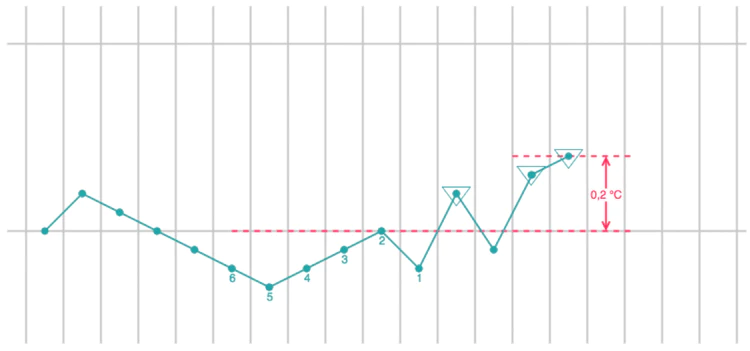
Exception rule 2
If, after the first higher measurement, the temperature on one day falls to or below the value of the highest of the six previous values, a further day must also be waited for. If on this fourth day the temperature is then at least 0.2°C above the value of the highest of the six previous values, the temperature evaluation is considered complete.
Exception rules 1 and 2 may not be combined.
Release after completion of cervical mucus evaluation and temperature evaluation
On the evening of the last day on which both evaluations could be completed, infertility can be assumed for the cycle phase after ovulation.
In the trackle app, this happens at 7 pm according to UTC+1.
Rules for determining the infertile phase before ovulation
For the first phase of the cycle, determination of the infertile time occurs according to the 5-day rule and the minus-8 rule.
The 5-day rule states that the first five days of the cycle can be assumed to be infertile unless otherwise determined by the minus-8 rule.
The minus-8 rule states that the cycle day with the earliest first higher measurement minus 8 gives the number of infertile days of the first cycle phase. If this rule yields fewer than 5 days, the rule must be applied immediately. If this rule yields more than 5 days, the rule may only be applied when the user has shown evidence of at least 12 preceding temperature rise phases.
Disruptive factors
Disruptive factors can cause an increase in basal body temperature without ovulation having occurred yet. It’s essential to note that each of us is different and reacts differently to stress, etc. You can recognize a ‚disrupted‘ temperature reading when your temperature suddenly rises for one or two days and then falls again.
Common disruptive factors that affect basal body temperature in many women include:
- Drug use
- Unusual alcohol consumption
- Short/disturbed sleep
- Stress – Time changes
- Cold or illness, and more.
Entering a disruptive factor into the app causes that temperature reading to be excluded and not included in the cycle evaluation. So, if there is a disruptive factor present and the temperature reading shows an unusual increase, a disruptive factor must be selected in the app for correct evaluation. If a disruptive factor has no effect on the temperature, no disruptive factor is selected in the app.
You can find more information on disruptive factors here.
Specific indicators on trackle
Fertility status on the turquoise tab (home screen)
trackle updates the evaluation of your fertility every day, regardless of whether new temperatures or observations have been added or not. Why is that? The system updates your evaluations every day, even if no new inputs have been made, because the passage of time without new observations alone causes changes. For example, if yesterday you were told that ovulation was predicted for tomorrow, this prediction will no longer be upheld today – either ovulation could be confirmed, then it will be displayed, or the prediction could not be confirmed, then fertility will continue to be displayed.
Each input regarding bleeding, cervical mucus, disruptions, and each transmission of temperatures immediately affects the evaluation. Therefore, the user must check their current daily fertility status on the turquoise tab every day: Only the indication displayed there takes into account all available data and determines the current fertility.
Retrospective determination of ovulation in the calendar
Once the evaluation of the peak in cervical mucus and the rise in temperature is completed, and the remaining days of the cycle are marked as infertile, trackle retrospectively indicates which days were actually fertile and on which day ovulation most likely occurred.
Forecasts
In the calendar, an approximate forecast is displayed several days in advance of when the next ovulation might occur and when the next menstruation might occur. These forecasts are only for rough guidance for the user and must not be used for contraception purposes. For the decision of whether unprotected intercourse is possible today without getting pregnant when using it for contraception, the display on the turquoise tab must always be checked daily.