The female cycle explained simply
The female cycle is so much more than the interplay of different hormones:
It is the rhythm of your life, the captain at the helm of your mood, and the basis for the creation of new life. We think that’s amazing, impressive, and a cause for celebration. What nature has come up with here is a true miracle. But even miracles don’t just have to happen to us, do they?
It’s important that you know your cycle and know what to expect. So we are going to explain the four cycle phases, that people with a cycle experience every single month, with a focus on in which phase of the cycle you can get pregnant.
The 4 phases of the cycle
Phase 1: Menstruation
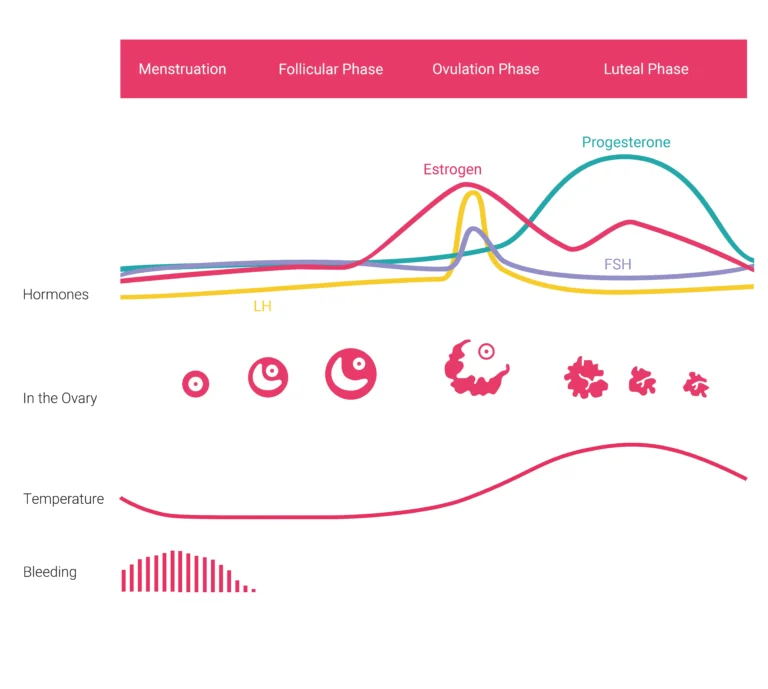
"Phase 1: Menstruation You probably already know the first phase of the cycle, as its signs are very noticeable: menstruation. The bleeding that occurs here marks the first day of your new cycle. It is triggered when no fertilized egg has implanted in the previous cycle: the uterine lining that isn't required is shed. During the menstruation phase, the hormones progesterone and estrogen are at their lowest. Many individuals with a cycle tend to withdraw during this phase, become more reflective, and need time for themselves. Menstruation usually lasts for three to seven days."
Phase 2: Follicular Phase
After menstruation, your body begins preparing for pregnancy: The hormone FSH (follicle-stimulating hormone) causes several follicles (egg sacs) to mature, increasing the level of estrogen in the blood. During this phase of the cycle, it is common to feel creative and full of energy. Meanwhile, the uterus starts preparing the lining for potential implantation from scratch. The length of the follicular phase can vary in time: Although it usually lasts between six and 21 days, it can significantly extend due to various factors such as stress, illness, and many more. If the follicular phase lengthens, ovulation will shift correspondingly.
Phase 3: Ovulation Phase
The third phase of the cycle revolves around your ovulation. When enough estrogen has been produced, the hormone LH joins in and triggers ovulation. The most developed egg now leaves its follicle and begins its journey through the fallopian tube towards the uterus. The egg itself is now fertile for 12-18 hours. Nature has been especially considerate here: Around ovulation, you often feel energized, confident, and have an increased libido.
Phase 4: Luteal Phase
In the luteal phase, the follicle from which the egg has burst becomes an important element in the cycle: it forms the corpus luteum, which produces progesterone. That's why this phase is also called the "corpus luteum phase." Progesterone not only causes the body's core temperature to rise by 0.2 - 0.5 degrees; it also thickens the uterine lining so that the fertilized egg can implant there. If fertilization does not occur, the corpus luteum dies, progesterone levels drop again, and the uterine lining is shed with the next period. The drop in your hormones can also lead to mood swings and increased sensitivity. Premenstrual syndrome (PMS) can also manifest itself during this phase. The luteal phase is very consistent in duration and usually lasts 12 - 16 days. The cool thing is: if you know when your ovulation occurred, then you also know when your next period will occur.
When am I fertile in my cycle?
In each cycle, the fertile phase is a maximum of seven days: These seven days include both ovulation itself, during which the egg can be fertilized for around 12-18 hours, and up to five days beforehand, because sperm can last up to five days in the female body.
Fertility is therefore highest in the follicular phase because your egg is about to make its way into the fallopian tube. So if you have already had unprotected intercourse, the egg can meet the sperm that are already waiting for it here. Of course, fertility also exists in the ovulation phase itself.
But if you now think that pregnancy is impossible during menstruation, we unfortunately have to disappoint you.
Due to a very short follicular phase, fertility can already occur during your period. No egg cell can implant in the uterus while the uterine lining is shed. However, due to the survivability of the sperm, there is still a chance of pregnancy if you have previously had unprotected sex.
Pregnancy is no longer possible in the luteal phase because the egg cell’s fertile phase is over. Another ovulation within the same cycle is anatomically impossible due to the high release of progesterone, which causes the core body temperature to rise.
However, ovulation does not always occur on the same day of the cycle, but sometimes earlier and sometimes later. In order to determine the fertile days as accurately as possible, ovulation must be found.
And trackle can help you with that!
By reliably changing your body signs such as the appearance of cervical mucus and the increase in core body temperature, ovulation can be precisely determined.
This knowledge you can use to either plan or avoid a pregnancy – you decide.“